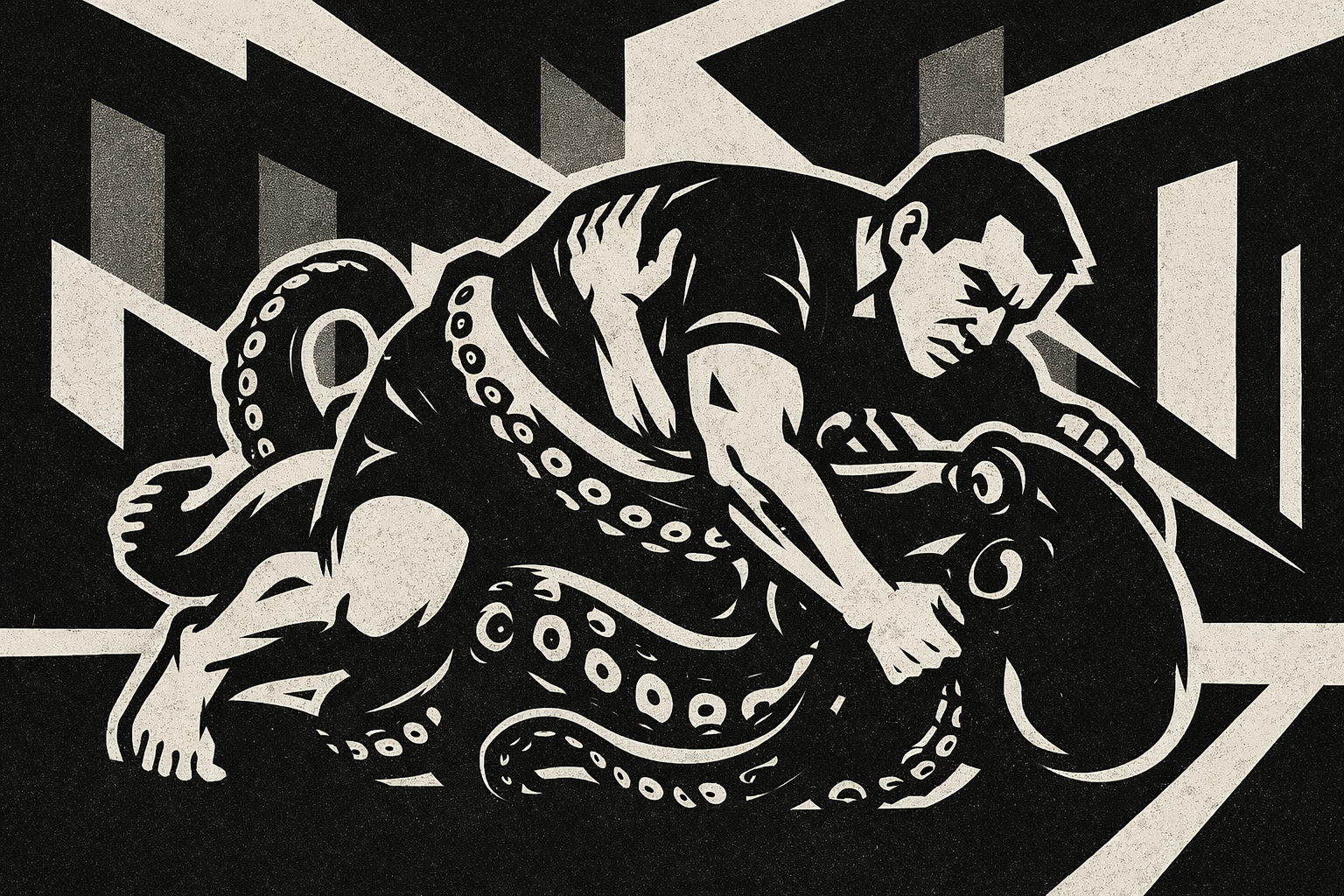
Once seen as a quirky side project, the octopus guard has become a legit weapon in modern no-gi. It flips the usual bottom-game script: sit up, steal the angle, and attack posture instead of accepting pressure.
Content
- What the Octopus Guard Is
- Where It Came From
- The Core Idea: Don't Force It
- Entering from Closed Guard
- Entering from Half Guard
- Height, Head Position, and Common Failures
- Sweeps, Back Takes, and Attacks
- Using It in the Gi
What the Octopus Guard Is
The octopus guard is an open-guard position where the bottom player sits up and wraps behind the opponent's upper body, usually with an underhook around the far armpit and a grip on the lat or torso. You're not flattening and defending--you're climbing to posture control and forcing the top player to carry your weight.
Typical entries show up from closed guard, half guard (especially knee shield/Z-guard), or chaotic scrambles when someone overcommits forward.
Where It Came From
The position is most strongly associated with Eduardo Telles, who built a competitive style around attacking from turtle and transitional guards. For years, it stayed niche, until no-gi athletes like Craig Jones started showing how effective it is against pressure passing.
The Core Idea: Don't Force It
The octopus guard isn't a position you insist on holding. It's something you find when your opponent drives too far forward, leaves an arm behind, or commits heavily to a crossface. Think of it as a pressure reaction, not a static guard.
A clean example of this reaction from half guard is here: Finding the Octopus Guard from Half Guard.
Entering from Closed Guard
Closed guard entries usually start with arm isolation. Break posture, drag an arm across your centerline, then sit up and pivot toward that side. Once you shoot the far underhook, open your guard and post your outside hand to build height.
If your closed guard foundation needs a refresh, we covered it in detail here: Closed Guard: A Modern Blueprint.
The key detail is height. If you stay flat, you'll get crossfaced and crushed. If your head is higher than theirs, they suddenly feel unstable.
Entering from Half Guard
The octopus guard really shines from knee shield / Z-guard. When they drive a heavy crossface and try to flatten you, you block the face, sit up under their armpit, and wrap behind the back with your underhook. Your head pops out on the far side and now they're carrying your weight instead of passing.
Height, Head Position, and Common Failures
Most failed attempts come down to one mistake: staying low. Treat octopus guard like a wrestle-up. If they back away, it's not a failure--it's an opening to stand up, snap down, or chain into a takedown.
If your face gets pinned by a crossface early, bail and recover guard. The octopus guard only works when you win the head position.
Sweeps, Back Takes, and Attacks
Once the underhook is established and your posture is high, the options open fast:
- Sweeps: Hip-bump and lateral off-balancing sweeps, often by trapping a leg.
- Back takes: If they pull their arm free or turn away, their back is exposed.
- Upper-body attacks: Overhooks can lead to kimura grips for sweeps or submissions.
- Creative options: Scrambles can expose buggy chokes and front headlocks.
Example: Buggy Choke Entry from Octopus-Style Transitions.
Using It in the Gi
The octopus guard works well in the gi too, with belt and lapel grips adding control and making the position feel more methodical. Adam Wardzinski has excellent examples of connecting octopus guard with butterfly and half guard:
Gi Octopus Guard Concepts and Octopus Guard from Half Guard (Gi).
Final Thoughts
The octopus guard isn't magic. But used at the right moment--against pressure and overcommitment--it turns defense into offense faster than most traditional guards. Train it patiently, let the position come to you, and embrace the chaos.
Want to Learn Faster?
If you want to progress more efficiently and actually understand what's happening in your game, check out Grappling AI. Log your training with quick voice notes and get structured breakdowns, statistics, and personalized insights as patterns emerge.